When a Weapon Is Involved: What Should Staff Actually Do?
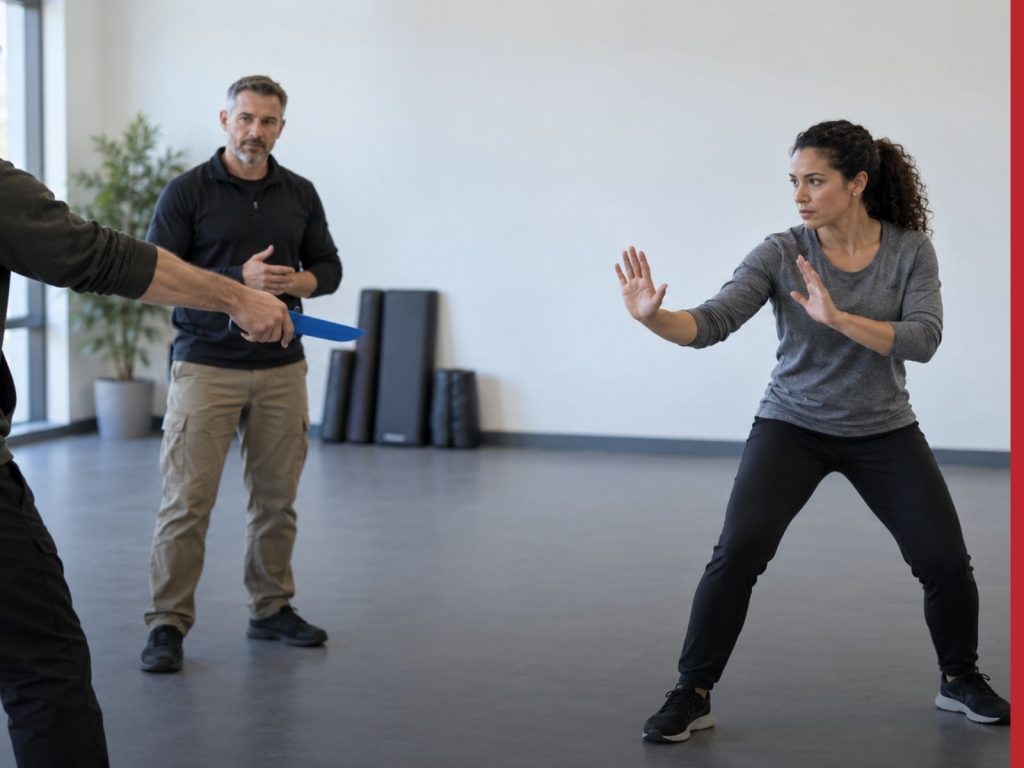
Most workplace conflict training begins with the aim of stopping a situation escalating. Recognise the warning signs, communicate clearly, create space and, wherever possible, resolve the situation before anybody is put at physical risk – But, what happens when a weapon is involved?
It is an uncomfortable scenario to think about, particularly for organisations whose staff work directly with members of the public, patients, residents or service users. It is also a situation where the wrong assumption about training can be dangerous. Weapon-related training is not about teaching somebody to become a hero. In fact, one of the most important lessons is often the opposite: if you can safely get away from the threat, you should. Nick Attard, General Manager at BR Specialists, says this is something the trainers make very clear.
“People sometimes hear ‘weapon disarming’ and imagine the training is about immediately trying to take a weapon from somebody. It isn’t. If you can get yourself and other people away safely, that is your first option. Physical intervention is what we look at when those safer options are no longer available.”
The latest Office for National Statistics figures show that police recorded 48,774 offences involving knives or sharp instruments in England and Wales in the year ending March 2026. That was an 8% fall compared with the previous year, which is welcome, but still represents tens of thousands of incidents involving a weapon. These are general crime figures rather than workplace-specific statistics, but they illustrate why organisations should not assume that such situations could never affect their staff.
For employees who may work alone, deal with distressed or unpredictable individuals, work in healthcare or care environments, provide security, or regularly encounter members of the public, thinking about the possibility before it happens can make a significant difference.
The priority is creating options
When a weapon appears, the dynamics of an incident change immediately. Something that might previously have been managed verbally can become a serious threat to life within seconds – Training therefore needs to start with decision-making rather than physical technique.
Staff need to understand their surroundings, recognise escape routes, maintain distance where possible and avoid unnecessarily placing themselves between an aggressor and an exit. They also need to understand that protecting themselves is not selfish. Their own safety has to be part of the decision. A simple way of thinking about the priorities is:
| Situation | Priority |
|---|---|
| A safe route away is available | Create distance and leave the situation |
| Other people can be moved away safely | Encourage them towards safety without unnecessarily approaching the threat |
| Communication remains possible | Keep communication calm, simple and non-confrontational |
| The person is agitated but not advancing | Avoid closing distance or creating additional pressure |
| No safe escape is available and an immediate attack occurs | Use trained responses appropriate to the situation as a last resort |
| The immediate danger has passed | Move to safety, summon emergency assistance and follow organisational procedures |
There is an important distinction between knowing that you should escape and being able to recognise the moment when that opportunity exists, under pressure, people may freeze, move towards rather than away from danger, become focused on the weapon itself or make decisions they would never make in an ordinary situation. This is one reason practical, face-to-face training matters, as Nick explains:
“When something happens quickly, people don’t suddenly become better at dealing with pressure. They tend to fall back on what they know and what they have practised. Our job is to give them sensible options and help them understand which option is appropriate, rather than teaching one response and pretending it will fit every situation.”
The environment also matters, a confrontation in a hospital corridor is different from one behind a reception desk, inside somebody’s home, in a care setting or in a busy hospitality venue; Doors, furniture, other people, confined spaces and escape routes all affect the choices available, that is why weapon-related training cannot realistically be reduced to learning a sequence of movements.
BR Specialists’ Weapon Disarming training begins with the principle that self-defence or disarming techniques should only be considered when other options have failed. The course also looks at assessing the environment, identifying the safest available escape and understanding the legal context around defending yourself – Where physical skills are taught, they form one part of that much wider decision-making process.
The aim is not to give somebody false confidence that they can safely overpower an armed person. Any encounter involving a weapon carries serious risk, Nick says:
“There is no technique that makes a weapon harmless. We are very clear about that. Training is about improving somebody’s chances of making a good decision in a very bad situation. Sometimes that decision is to run. Sometimes it is to create space. In the most serious circumstances, when there genuinely is nowhere else to go, having practised an appropriate response is better than having no plan at all.”
That distinction is particularly important for organisations reviewing their own procedures, a written instruction telling staff not to intervene may be completely appropriate, but employers should still consider what happens if a member of staff cannot simply remove themselves. A lone worker may find their exit blocked. A healthcare worker may be in a confined room. Another employee may suddenly find themselves close to an incident they did not initiate.
Training allows those difficult situations to be discussed before somebody encounters them for real, it also provides an opportunity to reinforce something that applies across almost every aspect of conflict management: prevention remains preferable to intervention. Recognising changing behaviour, noticing what is happening around you, maintaining appropriate distance, knowing where your exits are and responding early to escalating behaviour can all reduce the likelihood of somebody reaching the point where physical action is required.
Weapon-related incidents are rare for many organisations, but rarity does not mean they should automatically be ignored. Where an organisation’s risk assessment identifies a credible possibility, staff should understand both what they should do and, equally importantly, what they should avoid doing, the objective is not bravery, it is safer decision-making.
BR Specialists provides face-to-face Weapon Disarming training for organisations whose staff may be exposed to the risk of an armed assailant, alongside conflict management, personal safety, breakaway and physical intervention training. If you would like to discuss the risks your staff face and the most appropriate training for your organisation, contact the BR Specialists team on 01633 415353 or email training@brspecialists.co.uk.